
An agent can produce a confident, well-written final answer while a step in the middle silently failed. A subagent may have returned nothing, an action may have errored and been retried, or a retrieval step may have found irrelevant records. If you only evaluate the final response, none of this is visible.
Per-step scoring evaluates each stage of execution - subagent calls, action invocations, and response generation - as its own measurable unit. This turns observability from reading transcripts into tracking quality at the point where it is created.
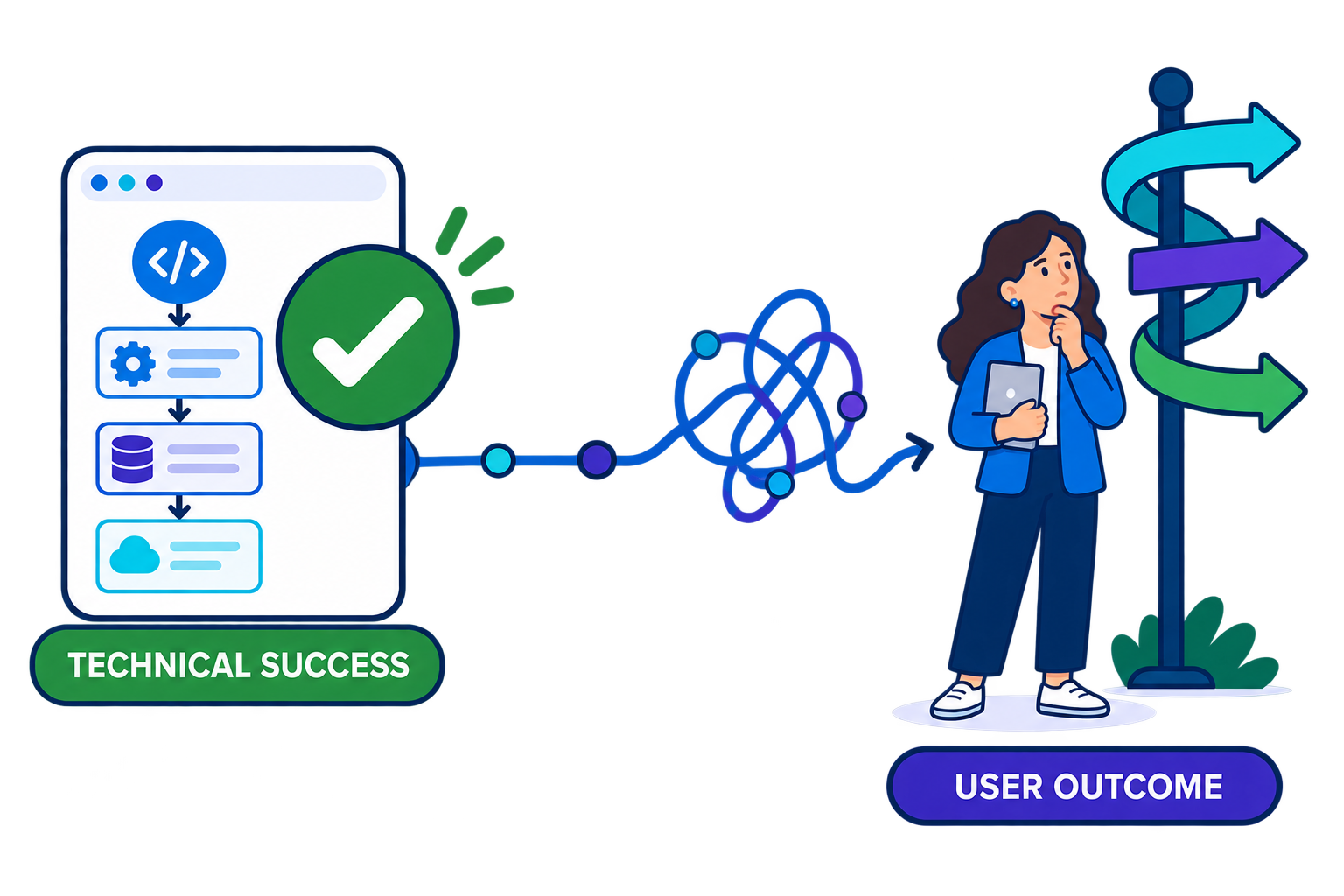
Watch the steps, not just the answer
- A correct final answer can conceal a failed subagent handoff, a skipped action, or a degraded tool response.
- Each step type fails differently, so each needs its own scoring criteria rather than one generic quality score.
- Step-level scores create leading indicators that predict final-answer quality before users report problems.
- A failing step that is compensated downstream still counts as a defect and should be recorded, not excused.
Score each execution stage
- Use session tracing to enumerate every subagent, action, and response step in a conversation and confirm none are dropped from evaluation.
- Define per-step pass criteria: correct subagent selection, valid action inputs, successful action execution, and grounded response content.
- Run test batches in Agentforce Testing Center and review step-level results alongside the final response, not instead of it.
- Track step failure rates over time in analytics and alert when a specific step type degrades even while final answers hold steady.
Resources
This article is based on the following Salesforce learning and product documentation.