
What is Set Up Testing Criteria in Agentforce architecture?
In Agentforce architecture, define expected subagents, actions, and response-level evaluation criteria. This guide explains the design decisions, controls, and implementation checks needed to apply the pattern in production.
A test utterance without an expected outcome is only sample traffic. Testing criteria convert it into an assertion about routing, tool use, and the response the user should receive.
Separating these expectations matters because a polished answer can conceal the wrong subagent or a missing action, while a correct action can still produce an unacceptable response.
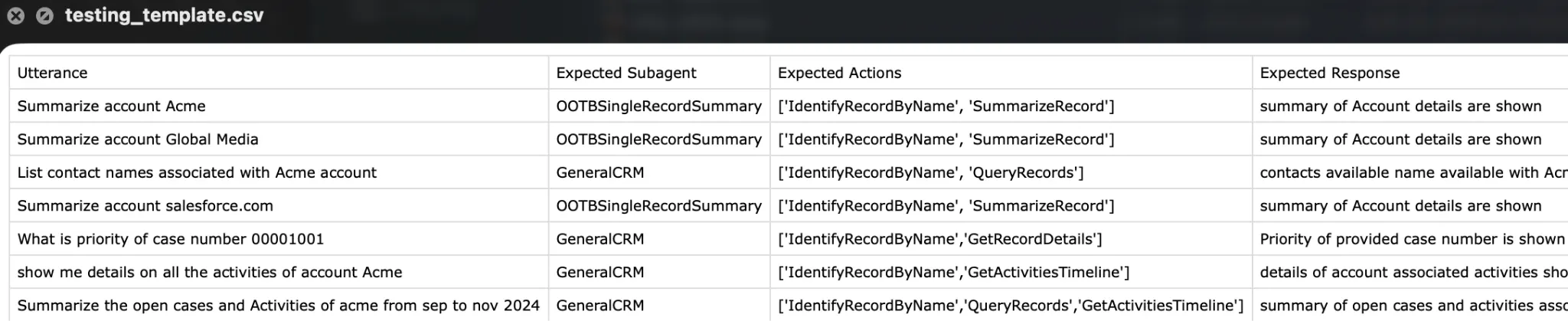
Define observable expectations
- Specify the expected subagent when correct routing is part of the workflow.
- List actions that must run, actions that may run, and actions that must never be available.
- Describe response criteria in terms of required facts, prohibited claims, tone, and escalation behavior.
- Use source-of-truth data and stable preconditions so failed tests are diagnosable.
Write stronger test cases
- Start each case with a business scenario, preconditions, utterance, and expected result.
- Add near-boundary values and paraphrases rather than repeating the same happy path.
- Mark critical safety and financial assertions separately from quality preferences.
- Version criteria alongside the agent behavior they validate.
Resources
This article is based on the following Salesforce learning and product documentation.