
What is Session Tracing in Agentforce architecture?
In Agentforce architecture, inspect turn-by-turn interactions, actions, inputs, outputs, errors, and final responses. This guide explains the design decisions, controls, and implementation checks needed to apply the pattern in production.
A fluent response can hide the wrong route, stale grounding, an omitted action, or a recovered error. Session tracing exposes the execution path behind the conversation so teams can investigate behavior with evidence.
The trace should be read as an ordered operational record: what the agent received, which subagent and actions it selected, how variables changed, what tools returned, and how long each step took.
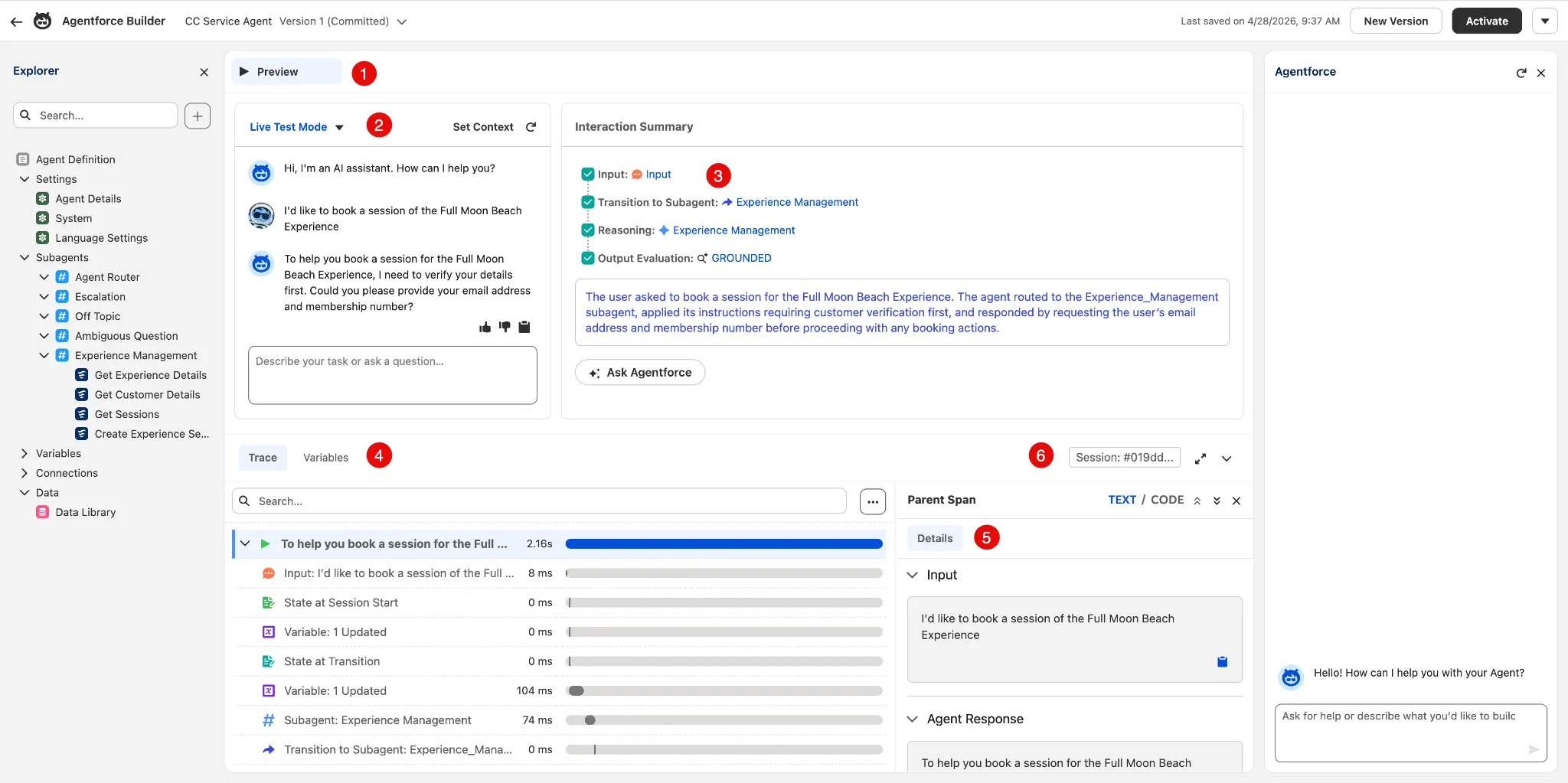
Read more than the transcript
- Compare the user-visible answer with the ordered processing steps that produced it.
- Check action inputs and outputs for data-shape, authorization, and error-handling problems.
- Use variable changes to find where an incorrect assumption first entered the session.
- Treat traces as sensitive operational data and apply appropriate access, retention, and review controls.
Investigate a failed session
- Start with the expected route, action, and outcome for the user's request.
- Find the first trace step that diverged from that expectation rather than debugging the final message alone.
- Classify the cause as routing, grounding, instruction, action, integration, permission, or response quality.
- Fix the responsible layer, reproduce the session in testing, and retain it as a regression case.
Resources
This article is based on the following Salesforce learning and product documentation.