
What is Conditional Logic for Agent Context in Agentforce architecture?
In Agentforce architecture, route prompts and action paths from explicit variables and evaluated conditions. This guide explains the design decisions, controls, and implementation checks needed to apply the pattern in production.
One large prompt that describes every customer tier, exception, and workflow becomes difficult to test and easy to misinterpret. Conditional logic lets the platform resolve known branches before the model receives its next instruction.
This keeps context focused: each branch can provide the right instruction, data, and follow-up for the current state without asking the model to rediscover deterministic business logic.
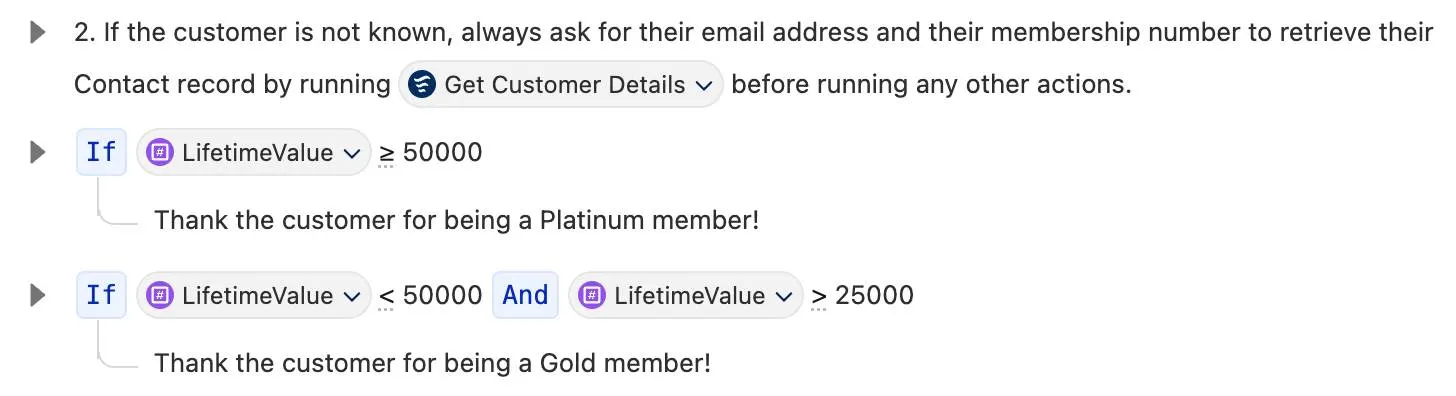
Keep deterministic decisions outside the prompt
- Branch on explicit variables derived from trusted data or completed actions.
- Give each branch a narrow instruction and only the context required for that path.
- Treat conditional prompt selection as routing, not as authorization to perform a sensitive action.
- Pair conditional logic with filters or backend validation when the branch controls money, access, deletion, or commitment.
Build and test the branches
- List mutually exclusive states and define a safe default when none match.
- Make branch conditions readable enough for a reviewer to understand without opening the prompt.
- Test every branch plus missing, stale, and contradictory variable states.
- Inspect traces to confirm the evaluated condition and selected instruction match the source data.
Resources
This article is based on the following Salesforce learning and product documentation.